25/6/1945 to 11/1945
Wing Commander G.D. Stephenson
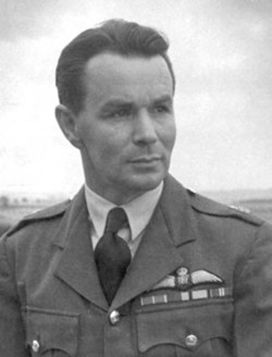
Lincolnshire, the district of Horncastle, welcomed Geoffrey Dalton Stephenson to the world on 19th January 1910. His Father William Dalton Stephenson was a Farmer in Horncastle, married to Jessie, Geoffrey was the couple’s first child.
Geoffrey was born into the aviation age; Bleriot had crossed the channel just under 2 years before his birth. Military us of aviation was reluctantly being allowed by the government. He was two years old when the Royal Flying Corps was formed, and four when the Great War started, and military aviation rapidly developed. In 1918 the Royal Air Force was formed by merging the RFC and RNAS, Geoffrey was the eight years old. The RAF had to wait 10 years before Geoffrey Dalton Stephenson was old enough to be welcomed into its ranks.
So, in 1928 Geoffrey entered Cranwell as a Flight Cadet, in ‘A’ Sqn. In the same intake was Douglas Bader. He represented the RAF College at Boxing, Athletics, Cross Country, and Swimming, attained the rank of Flight Cadet Sergeant and was awarded the ‘R M Groves’ Memorial Prize on graduation.
On 26th July 1930 Geoffrey was awarded a permanent commission and posted to 23 Squadron at Kenley, along with Douglas Bader.
Geoffrey was sent to Iraq in 1933, he was Adjutant. Armoured Car Unit, Iraq. Though this is not confirmed. 14 Jul 1933, he was PA to AOC, HQ Iraq Command. He returned to Britain and on 11th March 1935 became an instructor at RAF College Cranwell. In 1936 he moved to The Central Flying School as an instructor, also spending time as an instructor with the Oxford University Flying School. In 1937 he was a member of the CFS aerobatic team of three Avro Tutors.
On 10th December 1938 Geoffrey became the Personal Pilot, to the Inspector-General of the RAF.
In January 1940 Geoffrey took over of 19 Squadron based at Duxford. On 25th May the squadron moved to Hornchurch; the following day the squadron was supporting the evacuation from Dunkirk. Following an attack on Ju87s over Dunkirk, the squadron was attacked by Messerschmitt Bf109s of 1/JG1 and 2/JG2. This aircraft was hit in the radiator and forced to belly land on the beach west of Calais at around 8.45am. It is likely that this is one of the Spitfires claimed by Fw. Rudorffer of 2./JG2. The pilot, Squadron Leader GD Stephenson, was captured. In all, the squadron lost three Spitfires in the engagement, with one further aircraft damaged. Geoffrey spent a few days trying to escape but had to give himself up.
The aircraft, Spitfire Mk IA N3200, lay buried in the sand until it was recovered in 1986. After a period on display in the Mimoyecques V3 Museum, it was transported back to the UK for restoration. Work commenced in 2007, and the aircraft was returned to flying status in 2014 and was donated to the Imperial War Museum in 2015.
Geoffrey was to spend the rest of the war as a prisoner of war. Whilst in Stalag Luft I he acted as Senior British Officer. He was then transferred to Oflag IV-C, otherwise known as the infamous ‘Colditz’ He was later joined by another 19 Squadron pilot and RAF College colleague, Douglas Bader. During his time in captivity Geoffrey took part in the building of a glider, which alas never flew. In 1945 the camp was liberated by the allies and Geoffrey was repatriated back to Britain.
On 25th June 1945, Geoffrey was posted to RAF Bradwell Bay as Station Commander and stayed until November 1945. During this time, he married Ann Booth in Maldon. The couple went on to have 3 children. On 1st December 1945 Geoffrey became the Station Commander at RAF Spilsby.
In 1948 Geoffrey took over as Commandant, to the Central Flying School. 26th April 1949 he was appointed as ADC to the King. 10 Jun 1952 he was appointed ADC to The Queen. (effective from 6 Feb 1952). Geoffrey was considered one of the most experienced and capable fighter pilots in the RAF.
In 1954 Geoffrey was on an exchange tour with the United States Air Force, On 8 November 1954, Air Commodore Stephenson was flying a USAF F-100A-10-NA Super Sabre, 53-1534,[5] near Auxiliary Field 2 of Eglin Air Force Base, Florida. He was flying at 13,000 ft (4,000 m) as he joined formation with another F-100, flown by Capt. Lonnie R. Moore, jet ace of the Korean campaign, when his fighter dropped into a steep spiral, impacting at 14:14 in a pine forest on the Eglin Reservation, one mile NE of the runway of Pierce Field, Auxiliary Fld. 2.
The party of Air Commodore Stephenson, accompanied by 30 RAF and USAF officers, flew to Maxwell Air Force Base, Montgomery, Alabama, for interment at the Royal Air Force plot there. British armed forces traditionally bury their dead where they fall. There has been an RAF squad at Maxwell since World War II.
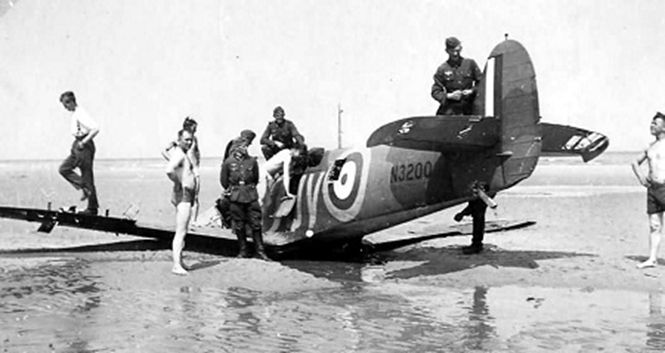
Supermarine Spitfire Mk 1a
Serial number: N3200
Unit: 19 Squadron
Call sign: QV –
Date of loss: 26th May 1940