22/3/1945 to 24/6/1945
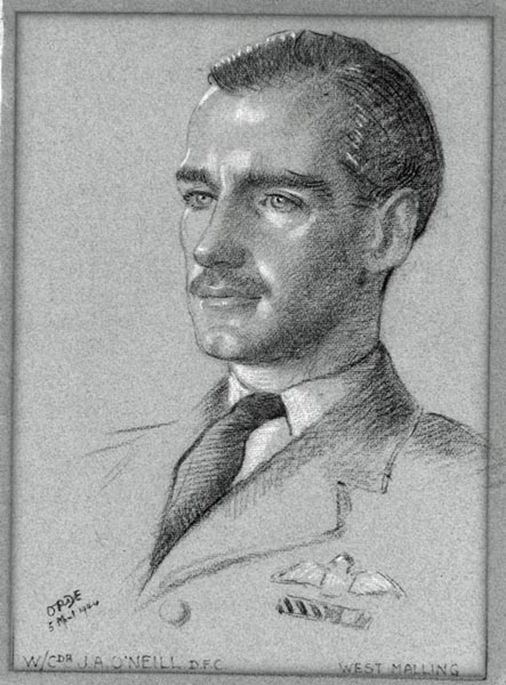
Group Captain J.A. O’Neill, D.F.C.
Watching the Schneider Races in the Solent inspired John Anthony O’Neill to join the RAF. John Anthony O’Neill was born on 7th October 1915 at Portsmouth and educated at St John’s College, Southsea.
Following his training John spent a year with 99 Squadron, a bomber squadron flying various bomber types such as the Handley Page Heyford, a biplane. In March 1937 John was posted to 58 Squadron. At the start of the Second World War 58 Squadron was based at RAF Linton-on-Ouse flying Whitley bombers as part of No. 4 Group RAF in RAF Bomber Command, flying its first mission of the war, a leaflet raid on the Ruhr, on the night of 3/4 September 1939. The ten Whitley’s which took part were the first RAF aircraft to fly over mainland Germany. Returning over France, one of O’Neill’s two engines failed and he was forced to crash-land in a cabbage field near Rheims. His aircraft was destroyed, the first on RAF operations to be lost in the war. Leaflet-dropping over the main cities of Germany – officially called ‘Nickel Raids’ but referred to irreverently as ‘bumf bombing’ by the crews – was the principal activity for the Whitley force during the early days of the war.
After a spell in Coastal Command supporting convoys, the squadron returned to bombing operations in April 1940, and later that month O’Neill attacked the airfields at Fornebu and Stavangar in Norway. Following the Blitzkreig on 10th May he attacked Maastricht airfield, and five days later bombed Germany for the first time when he went to Düsseldorf, where his aircraft was badly damaged by anti-aircraft fire.
Over the next few weeks, he was constantly in action, bombing communications targets and bridges in north-west France and Belgium in support of the British Expeditionary Force.
He also bombed targets in Germany, and on 11th June he took off from Guernsey on the RAF’s first raid against Italy – most of the Whitley’s, however, including O’Neill’s, were forced to turn back over the Alps when their aircraft became covered in ice. In the last two weeks of June, he flew eight more bombing operations over Germany before being sent to Ringway to help establish the RAF’s first parachute training school.
John was awarded the Distinguished Flying Cross. (gazetted 30th July 1940 for his service with 58 Squadron). His younger brother, Hugh, also won the DFC and a bar to it.
John, transferred to fighter command as he wanted to be a fighter pilot and was posted to 238 Squadron as a flight commander, and he flew from the south of England during the latter phases of the Battle of Britain. After returning to 601, on 16th April 1941 he shot down a Messerschmitt 109, but was immediately attacked from behind and forced to bale out, landing in the sea off Dungeness. He was quickly rescued, but not before he had become eligible for membership of the Caterpillar and Goldfish Clubs. During his convalescence at an RAF rehabilitation centre, he met his wife – ‘the one good turn the Germans did me’ he would say. He married Phyliss Nichols in Westminster in the spring of 1944.
He was promoted to Wing Commander and posted to Alipore in India in June 1942 to lead 165 Fighter Wing, charged with the defence of Calcutta. On the night of 23rd December, he was flying a Hurricane when he intercepted three Japanese bombers; he attacked them, damaging one.
The next night he was scrambled to intercept 10 Mitsubishi Ki-21 bombers approaching Calcutta and was credited with destroying one – the first over India at night, an event which attracted widespread coverage in the British and Indian newspapers.
With the arrival of the Beaufighter in India at the end of 1942, O’Neill took command of one of the first squadrons, 176, based at Dum Dum, Calcutta. Six months later he was invalided home with jaundice. During the last two years of the war, he commanded four different night fighter airfields in the south of England, from where his Beaufighter and Mosquito squadrons flew intruder sorties over north-west Europe. He came to RAF Bradwell Bay on 22/3/1945 and left on 24/6/1945. During his tenure at RAF Bradwell Bay, peace came to Europe on 8th May 1945. The war with Japan did not end until 15th August 1945, when World War 2 came to an end.
O’Neill remained in the RAF after the war, and in March 1950 was appointed as the first British air attaché to the two-year-old state of Israel. In the years leading up to this time there had been several major air incidents, including the shooting down of four RAF Spitfires by the Israeli Air Force and the sabotage of a number of RAF aircraft on the ground by Irgun terrorists. Shortly after he had taken up the appointment, a Sunderland flying boat en route from Bahrain to the Canal Zone strayed off course, and Israeli fighters forced it to land on the water at Tel Aviv. The crew were taken captive, and O’Neill played an important part in securing their release.
After attending the Nato Defence College in Paris in August 1954, O’Neill took up an appointment at the Nato headquarters at Fontainebleau. He retired from the RAF in November 1957. During his RAF career he had flown 60 types of aircraft. He would often remark: ‘We were doing a job we loved and being paid for it’.
Paul joined Allied Suppliers and spent several years in Chile and Peru as Sales Director of Lipton’s Tea. After his second retirement he was invited to join the Government Hospitality Fund in a part-time post for which his diplomatic and RAF experience perfectly suited him; he spent 10 years escorting various foreign heads of state and VIPs visiting Britain as guests of the government.
A keen golfer and gardener, O’Neill was also polite, modest and self-effacing. He showed great courage in coping with failing health and eyesight. After the death of his wife, he drew much comfort from his family and his Roman Catholic faith.
Paul Anthony O’Neill died on 15th May 2008, aged 92. He married, in 1944, Phyllis Nichols. She died in 2005, and he is survived by their daughter.