
24/5/1944 to 10/7/1944
Wing Commander George ffolliott Powell-Shedden, D.S.O., D.F.C.
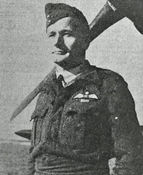
Born in the Middle of the Great War in 1916, on the Isle of Wight, to a father who was a regular officer in the Royal Artillery, it was almost inevitable that George ffolliott Powell-Shedden would pursue a military Career. After attending Wellington College, at the age of 18, in 1934, he enrolled into the Royal Military Academy at Woolwich. In January 1935, with his head in the clouds, he transferred to the RAF College at Cranwell and graduated in December 1936 with a permanent commission.
His first posting was to Khartoum on 11th January 1937, where he joined 47 Squadron, who were flying Fairy Gordons followed in July by Vickers Vincent’s on policing duties in the Middle East. In 1939 George was posted to 33 Squadron in Mersa Matruh in Egypt as a Flight Commander. He returned to the UK in June 1940, where he attended a refresher course at 6 OTU, which was based at RAF Sutton Bridge in Lincolnshire. In 1940 he married Diana Eve Higgs from Nottinghamshire.
At 6 OTU George converted to Hurricanes and was posted to 242 squadron based at Coltishall in Norfolk. He joined the squadron on 30th June as Commander of B Flight. The Squadron Commander was Douglas Bader. This was Douglas Bader’s first squadron, and it was difficult for the squadron, mostly Canadians to accept him. Once the squadron settled down and became operational, George shot down a JU88 on 23rd July. He is credited with a few aircraft shot down and shared 2 others. Unfortunately, he was shot down and baled out into the East Sussex Village of Udimore. He was taken to Rye Hospital with a dislocated shoulder, and then transferred to the RAF Hospital at Rauceby.
He had recovered by 22nd November 1940 and was posted to 258 Squadron as a Flight Commander. In April 1941 he took over command of 615 squadron in RAF Valley.
He was posted to Malta, arriving on 19th July 1941, with orders to form a new squadron. At the end of the month the Malta Night Fighter Unit came into being at Ta Kali, with Hurricanes. During the night of 11th/12th August George damaged a Fiat BR20 and on the 26th/27th two more BR20s. The MNFU was renamed 1435 (Night Fighter) Flight on 2nd December 1941 and George handed over command.
He was awarded the DFC (gazetted 12th December 1941).
In January 1942 he was promoted to Acting Wing Commander and appointed Wing Commander Ops at Ta Kali and was given control of airfield serviceability. He later went to the Middle East.
George returned to Britain, in January 1944, and was posted to 258 Squadron as supernumerary. 258 Squadron were based at West Malling. In March 1944 he took command of 96 squadron at Ford. He left the squadron in April 1944 and returned to 96 in July, staying with 96 Squadron until December 1944.
His Absence from 96 Squadron was spent as Station Commander at RAF Bradwell Bay, where he served from 24/5/1944 to 10/7/1944. This was a crucial time as it encompasses the Invasion of Europe on 6th June 1944. Aircraft from Bradwell provided air support at this time. He was awarded the DSO (gazetted 27th April 1945).
After the war George represented the UK in the 1948 Olympics as part of the British Bobsleigh team, which was made up entirely of RAF personnel. A keen sportsman at Wellington College, George played for the rugby XV and was also the school’s heavyweight boxing champion.
In 1952 he received command of RAF Jever in Germany and from 1954 to 1957 served on the operational staff at Naples, before concluding his service career at the Air Ministry.
George retired from the RAF on 20th March 1961 as a Group Captain; he joined the Stock Exchange as a Stockbroker. In 1963 George married Marietta Bianca F Von Foglar-deinhardstein, who died in 2009. George died on 31st October 1994 in Camden, London.
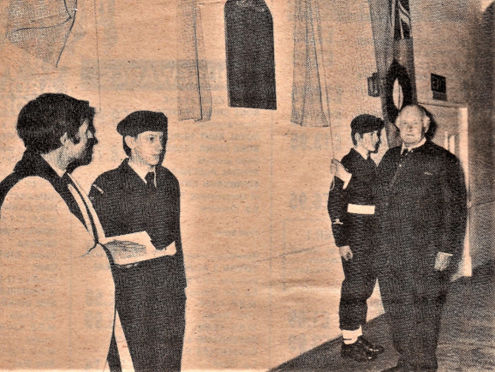
George ff Powell-Shedden unveiling a memorial in Essex in 1978.